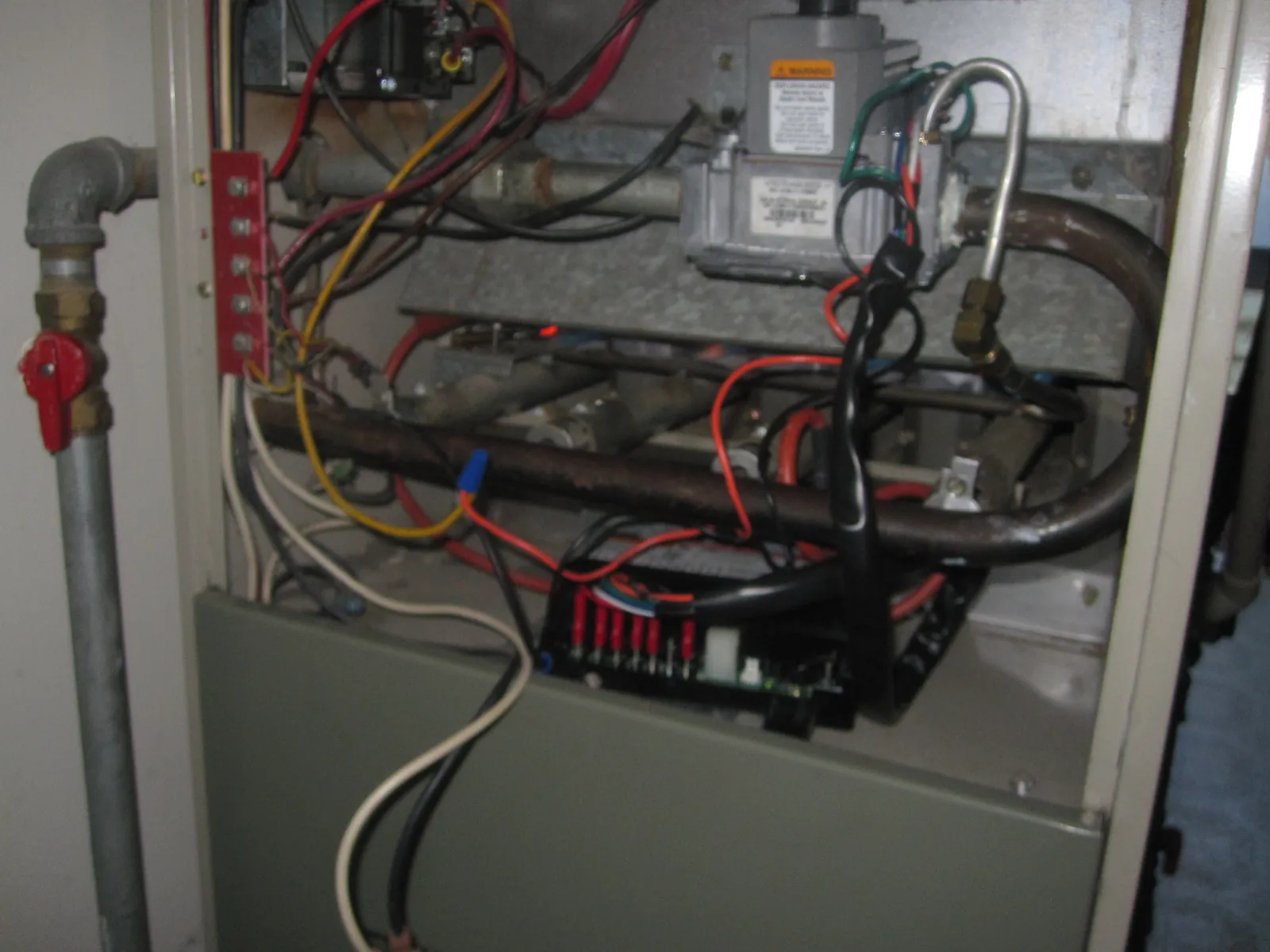
Furnace repair in Aurora, CO for gas furnaces in basements, utility closets, crawlspaces and attached garages. The calls that come in most: a furnace that runs but blows cold air, burners that light and then shut off, an igniter that glows with no flame, a blower that will not start, and a furnace that hums, rattles or squeals.
Most homes in Meadowood, Mission Viejo and the neighborhoods around them heat with a gas furnace. Repairs cover the burner side, the air side and the controls that tie them together.
Gas Furnace Repair: Parts We Replace
- Hot surface igniters and older spark and pilot ignition
- Flame sensors, flame rollout switches and high limit switches
- Draft inducer motors and the pressure switches and hoses that prove draft
- Gas valves and burner assemblies
- Blower motors, blower wheels and run capacitors
- Control boards, transformers, door switches and fuses
- Condensate traps, drain lines and pumps on 90 percent furnaces
- Exhaust and intake pipes, plus the vent connections at the furnace
A dirty flame sensor is the most common reason a furnace lights and shuts off a few seconds later. A cracked igniter is the next most common reason for no heat at all. Both sit inside the burner compartment and both wear out with run hours.
Furnaces in 1970s and 1980s Aurora Homes
The Census tract that covers most of Meadowood has a median build year of 1976, and about 30 percent of homes in 80013 went up before 1980. Many of those houses are on their second or third furnace. The original duct runs, the return air path and the flue were sized for the first unit, and a newer furnace can trip a limit switch or short cycle when the airflow does not match.
Aurora Cold Snaps and Furnace Breakdowns
NOAA normals for the Centennial Airport station, the closest official station to Meadowood, show about 155 nights a year at or below freezing and a January average low of 19 degrees. Denver's official record low is 29 below zero, set in January 1875 (NWS Denver January records). Long run times in December and January are when inducer motors, igniters and blower capacitors fail. On a high efficiency furnace, snow or frost can also block the intake and exhaust pipes on the side of the house.
For no-heat calls at night or on a weekend, see 24 hour furnace repair in Aurora. For older units with a cracked heat exchanger or repeated failures, see furnace replacement. Yearly service is on the furnace tune-up page. Nearby service also covers Meadow Hills, Summer Valley and the rest of the Aurora service area.
Sources and local offices: NOAA climate normals, Denver record cold list, 80013 housing data.
Questions About Furnace Repair
Why does my furnace keep running but no heat?
Cold air means the blower runs while the burners stay off or keep going out. Common causes are a dirty flame sensor, a failed igniter, a pressure switch that will not close because of a blocked vent or a weak inducer motor, or an overheating furnace that tripped its high limit. A clogged filter can cause the last one.
Why does my furnace cycle on and off every 5 minutes?
A furnace that restarts every few minutes is short cycling. The usual causes are a flame sensor coated with residue, so the board cannot prove flame, or a furnace that overheats from a clogged filter and trips its high limit. A thermostat near a supply vent can also cut every cycle short.
What noises are normal for a furnace?
A click from the relays, the hum of the inducer motor, a soft whoosh when the burners light, and the blower starting up a few seconds later. Metal ducts can tick as they warm up and cool down. Banging, squealing, grinding and rattling are not normal.
What is the most common furnace failure?
No heat from a dirty flame sensor or a cracked hot surface igniter. Both are small parts in the burner compartment and both are replaced often in Aurora winters.
What could be the reasons why my furnace isn't igniting?
A cracked igniter, a gas valve that does not open, a pressure switch that does not close, a failed inducer motor, or a control board that never sends the signal. A thermostat that is not calling for heat looks the same from the outside, so check that it is set to heat first.
Why is my furnace really loud all of a sudden?
Squealing often comes from a worn blower motor bearing. Rattling can be a loose panel or a cracked blower wheel. A loud bang at startup is usually delayed ignition from dirty burners. Grinding or roaring from the inducer motor means its bearings are failing.
What does a blower motor sound like when it's going bad?
A hum with no air moving, a high squeal, or a grinding sound that gets louder over a few days. A motor that starts slowly or needs a push to spin may have a weak capacitor rather than a bad motor.
Why won't my furnace stay running?
It is shutting itself off for a reason the control board can see: no flame signal, a high limit trip from low airflow, a pressure switch that opens from a blocked vent or drain, or a rollout switch that tripped. Many boards flash a code on an LED that points to which one.
What are the signs of a bad heat exchanger in a furnace?
Visible cracks or rust holes, soot around the burners or the flue, burner flames that dance or roll out when the blower starts, and a rollout switch that keeps tripping. A cracked heat exchanger usually means the furnace gets replaced rather than repaired.